
Advancing Oral Health, Clinical Dental Excellence and Community Well-being
Accreditation status: This programme has been developed by LUE in accordance with Eswatini Higher Education Council (ESHEC) Programme Approval Standards and is being submitted to ESHEC for accreditation. As a professional degree, the BDS/BCh.D additionally requires endorsement by the relevant national dental regulatory body prior to final ESHEC accreditation. Prospective applicants should confirm the current accreditation and regulatory-endorsement status of this programme with LUE’s Admissions Office before enrolling.
The LUE Bachelor of Dental Surgery (BDS / BCh.D) is dedicated to advancing oral health, clinical dental excellence and community well-being in the Kingdom of Eswatini and the Southern African region. The programme integrates rigorous dental science with early and sustained clinical exposure to produce safe, competent, ethical dentists equipped to serve Eswatini’s oral-healthcare needs.
A national STEPS survey found that 51.5% of Eswatini adults have never used a dental service, and only 12.7% had done so in the past 12 months — indicating substantial latent demand rather than low disease burden. Eswatini, Lesotho and Botswana all currently lack a domestic dental school; Emaswati citizens must train abroad.
Bachelor of Dental Surgery (BDS / BCh.D)
5 Years (10 Semesters), full-time
600 credits (6,000 notional hours) — 120 credits in each year
Level 8 — Professional Degree, with an ascending Level 6 → 7 → 8 structure (Year 1 foundational sciences, Year 2 pre-clinical dental sciences, Years 3–5 clinical practice)
Full-Time, Campus (in-person) Learning
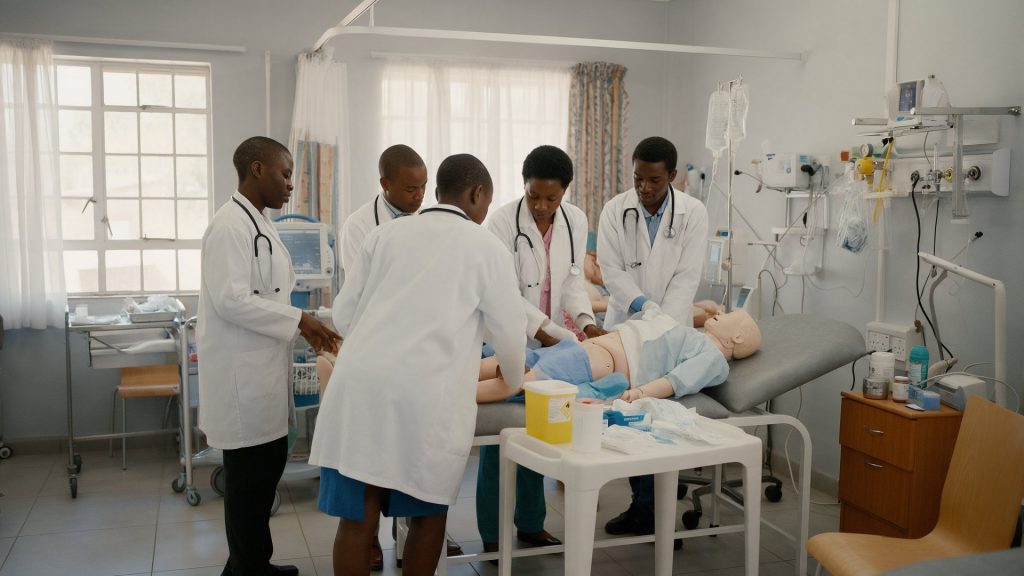
Supervised clinical placements in the dental teaching clinic and community settings from Year 3 onward, preceded by preclinical simulation-laboratory training in Year 2
A Year 5 Research Project/Dissertation on a topic relevant to Eswatini’s oral-health priorities, with a written dissertation and oral defence
Awarded as a single integrated professional qualification (ESQF Level 8), not subject to Pass/Honours differentiation, consistent with international practice for first professional dental degrees
Rigorous standards across the dental and biomedical sciences, fostering critical thinking and diagnostic reasoning. Engaging coursework, simulation-laboratory training and evidence-based practice equip students to excel in a demanding clinical discipline.
Students undertake supervised clinical placements in the dental teaching clinic and community settings from Year 3 onward. A capstone Community Dentistry and Oral Health Promotion placement and a supervised research dissertation consolidate this community orientation in the final year.
The programme responds directly to Eswatini’s severe dental-workforce shortage and the complete absence of local dental training capacity. Graduates are prepared to contribute to Eswatini’s health system, to postgraduate specialisation, and to the wider SADC region.
An ESQF-aligned BDS/BCh.D, benchmarked against the University of Pretoria’s BChD, supports comparability of dental qualifications across the region.
Anatomy for dental sciences, general physiology, biochemistry for dental sciences, oral biology and tooth morphology, systemic anatomy/physiology, oral microbiology, introduction to dentistry and ethics.
General and oral pathology, pharmacology and dental therapeutics, dental materials science, preclinical operative dentistry and prosthodontics I & II, research methodology.
Oral Medicine and Oral Diagnosis, Periodontology, Conservative Dentistry and Endodontics, Prosthodontics, Oral Radiology, Paediatric Dentistry, Clinical Dental Skills, Oral and Maxillofacial Surgery, Orthodontics, Restorative Dentistry, Clinical Dental Pharmacology, Forensic Odontology and Clinical Prosthodontics.
Comprehensive Clinical Dentistry I & II, Community Dentistry and Oral Health Promotion, Dental Public Health, Advanced Oral Surgery and Emergency Care, Integrated Oral Health Care, Professional Practice/Law/Ethics, Practice Management, Research Project/Dissertation.
The BDS/BCh.D is structured to ensure a coherent, cumulative and academically rigorous progression from foundational biomedical and dental sciences in Year 1 (ESQF Level 6), through pre-clinical dental sciences and simulation-laboratory training in Year 2 (ESQF Level 7), to progressively independent clinical practice across Years 3–5 (ESQF Level 8).
| Module | Credits |
|---|---|
| Human Anatomy for Dental Sciences I: Head and Neck | 20 cr. |
| General Physiology I | 15 cr. |
| Biochemistry for Dental Sciences | 10 cr. |
| Oral Biology and Tooth Morphology I | 15 cr. |
| Module | Credits |
|---|---|
| Systemic Anatomy and Physiology II | 15 cr. |
| General and Oral Microbiology | 15 cr. |
| Oral Biology and Tooth Morphology II | 15 cr. |
| Introduction to Dentistry, Ethics and Community/Preventive Dentistry I | 15 cr. |
| Module | Credits |
|---|---|
| General and Oral Pathology I | 15 cr. |
| Pharmacology and Dental Therapeutics | 15 cr. |
| Dental Materials Science I | 10 cr. |
| Preclinical Operative Dentistry I and Preclinical Prosthodontics I | 20 cr. |
| Module | Credits |
|---|---|
| General and Oral Pathology II | 15 cr. |
| Dental Materials Science II | 10 cr. |
| Preclinical Operative Dentistry II and Preclinical Prosthodontics II | 20 cr. |
| Research Methodology, Biostatistics and Community/Preventive Dentistry II | 15 cr. |
| Module | Credits |
|---|---|
| Oral Medicine and Oral Diagnosis I & II | 20 cr. |
| Periodontology I & II | 20 cr. |
| Conservative Dentistry and Endodontics I & II | 20 cr. |
| Prosthodontics I & II (Clinical) | 20 cr. |
| Oral Radiology and Imaging I | 10 cr. |
| Paediatric Dentistry I | 15 cr. |
| Clinical Dental Skills and Communication | 15 cr. |
| Module | Credits |
|---|---|
| Oral and Maxillofacial Surgery I & II | 25 cr. |
| Orthodontics I & II | 25 cr. |
| Paediatric Dentistry II | 15 cr. |
| Restorative Dentistry I & II | 25 cr. |
| Clinical Dental Pharmacology and Pain Management | 10 cr. |
| Forensic Odontology | 10 cr. |
| Clinical Prosthodontics | 10 cr. |
| Module | Credits |
|---|---|
| Comprehensive Clinical Dentistry I & II | 30 cr. |
| Community Dentistry and Oral Health Promotion | 15 cr. |
| Dental Public Health | 15 cr. |
| Advanced Oral Surgery and Emergency Care | 15 cr. |
| Integrated Oral Health Care | 10 cr. |
| Professional Practice, Law and Ethics | 10 cr. |
| Practice Management and Leadership | 5 cr. |
| Research Project / Dissertation | 20 cr. |
All modules within the BDS/BCh.D programme are compulsory and must be completed internally at LUE or at LUE-approved, MOU-affiliated clinical training sites. Full module descriptions, learning focus and key competencies for every module are set out in the BDS/BCh.D programme document, available to download from this page.
Within a few years of graduation, LUE BDS/BCh.D graduates are expected to be:
Graduates must register with the relevant national dental/health-professions regulatory authority before independent practice. Graduates may progress to postgraduate specialisation (Honours/PG Diploma/Masters, ESQF Level 9) at LUE or partner institutions.
Applicants who do not yet hold the required A-Level qualifications may apply via LUE’s Certificate in Pre-Admission Health Sciences (Foundation) — a one-year bridging programme covering the Biology, Chemistry, Physics and Mathematics prerequisites shared by the MBBS and BDS/BCh.D programmes.
Recognition of Prior Learning (RPL): mature learners with a minimum of 3–5 years of relevant dental, clinical, nursing or health-technology experience may be admitted through a structured RPL Portfolio of Evidence assessment. Admissions via the RPL route shall not constitute more than 10% of the annual intake.
All foreign qualifications must be accompanied by a Letter of Equivalence issued by the Eswatini Qualifications Authority (EQA). No foreign qualification shall be processed without this document.
Admission decisions are made by LUE’s Admissions Committee, based on: academic eligibility; EQA equivalence (where applicable); RPL PoE assessment (for RPL applicants); interview performance; and verification outcomes. The Committee’s decision is final and guided by LUE’s principles of fairness, academic integrity and institutional excellence.
LUE applies a mandated, faculty-wide assessment-weighting scheme to every BDS/BCh.D module: attendance (5%), internal formative assessment (35%) and end summative assessment (60%) — written examination and/or practical/clinical examination, as specified per module. All assessment is delivered via Campus (in-person) Learning, given the clinical, patient-facing nature of the programme.
Students must pass each module with a minimum grade of 50% to progress. During the clinical years (Years 3–5), all modules must be passed with a minimum grade of 60% (equivalent to a CGPA of 3.00) to qualify for progression and graduation, reflecting the higher safety standard required of direct patient care. Attendance at clinical teaching is compulsory; students who attend less than 80% of scheduled clinical sessions will not be permitted to sit the relevant sessional examination.
A second qualified examiner reviews all simulation-laboratory and clinical examinations and the Year 5 dissertation before results are finalised, and an appointed external examiner moderates assessment at the end of Year 2 and end of Year 5, at minimum.
| Assessment Component | Contribution | What It Covers |
|---|---|---|
| Attendance | 5% | Compulsory attendance at lectures, tutorials, simulation-laboratory and clinical sessions |
| Internal (Formative) Assessment | 35% | Written/online assignments and tests, homework, quizzes, simulation-laboratory practicals, case presentations, logbooks |
| End (Summative) Assessment | 60% | Written examination and/or Practical/Clinical Examination (as specified per module) |
| Supplementary Assessment | 100% | Written examination and/or Practical/Clinical Examination, for students undertaking an approved resit |
| Percentage Mark | Letter Grade | Grade Point | Interpretation |
|---|---|---|---|
| 80–100 | A+ | 4.00 | Exceptional |
| 70–79 | A | 4.00 | Excellent |
| 60–69 | B | 3.00 | Very Good |
| 50–59 | C | 2.00 | Good |
| 45–49 | D | 1.00 | Pass |
| 0–44 | F | 0.00 | Fail |
The BDS/BCh.D is awarded as a single integrated professional qualification (ESQF Level 8) and is not subject to Pass/Honours differentiation, consistent with international practice for first professional dental degrees. A minimum CGPA of 2.00 is required to remain in good academic standing.
The Bachelor of Dental Surgery is a five-year, full-time programme (10 semesters) worth 600 credits at ESQF Level 8, with 120 credits in each year. Year 1 covers foundational sciences, Year 2 pre-clinical dental sciences, and Years 3–5 are clinical.
Applicants who do not yet hold the required A-Level qualifications may apply via LUE’s Certificate in Pre-Admission Health Sciences (Foundation) — a one-year bridging programme covering the Biology, Chemistry, Physics and Mathematics prerequisites shared by the MBBS and BDS/BCh.D programmes.
Yes. Recognition of Prior Learning (RPL): mature learners with a minimum of 3–5 years of relevant dental, clinical, nursing or health-technology experience may be admitted through a structured RPL Portfolio of Evidence assessment. Admissions via the RPL route shall not constitute more than 10% of the annual intake. The Portfolio of Evidence comprises a Curriculum Vitae, a Reflective Narrative, Workplace Evidence, Letters of Reference and Relevant Certificates, and is followed by the standardised admissions interview.
This programme has been developed by LUE in accordance with Eswatini Higher Education Council (ESHEC) Programme Approval Standards and is being submitted to ESHEC for accreditation. As a professional degree, the BDS/BCh.D additionally requires endorsement by the relevant national dental regulatory body prior to final ESHEC accreditation. Prospective applicants should confirm the current accreditation and regulatory-endorsement status of this programme with LUE’s Admissions Office before enrolling.
Preclinical simulation-laboratory training in cavity preparation, restorative and prosthodontic techniques takes place in Year 2, before patient contact. Students undertake supervised clinical placements in the dental teaching clinic and community settings from Year 3 onward, with 4–6 students per supervising dentist in simulation-laboratory and chairside clinical supervision.
Students must pass each module with a minimum grade of 50% to progress. During the clinical years (Years 3–5), all modules must be passed with a minimum grade of 60% (equivalent to a CGPA of 3.00), reflecting the higher safety standard required of direct patient care.
Yes. Research Methodology, Biostatistics and Community/Preventive Dentistry II (Year 2) builds foundational research literacy, and the Year 5 Research Project/Dissertation requires each student to complete an independent, supervised research study on a question relevant to Eswatini’s oral-health priorities, culminating in a written dissertation and oral defence.
Within a few years of graduation, LUE BDS/BCh.D graduates are expected to be:
Admission decisions are made by LUE’s Admissions Committee, based on: academic eligibility; EQA equivalence (where applicable); RPL PoE assessment (for RPL applicants); interview performance; and verification outcomes. The Committee’s decision is final and guided by LUE’s principles of fairness, academic integrity and institutional excellence.
Have a question about this programme? Send us your details and the LUE Admissions Office will get back to you.
Five-year professional medical degree with three clinical clerkship years.
Four-year specialist training in five specialisations.
Faculty overview, programmes and the Dean’s message.
Contact the LUE Admissions Office for the application form and to confirm the programme’s accreditation and regulatory-endorsement status before you apply.